
Abstract
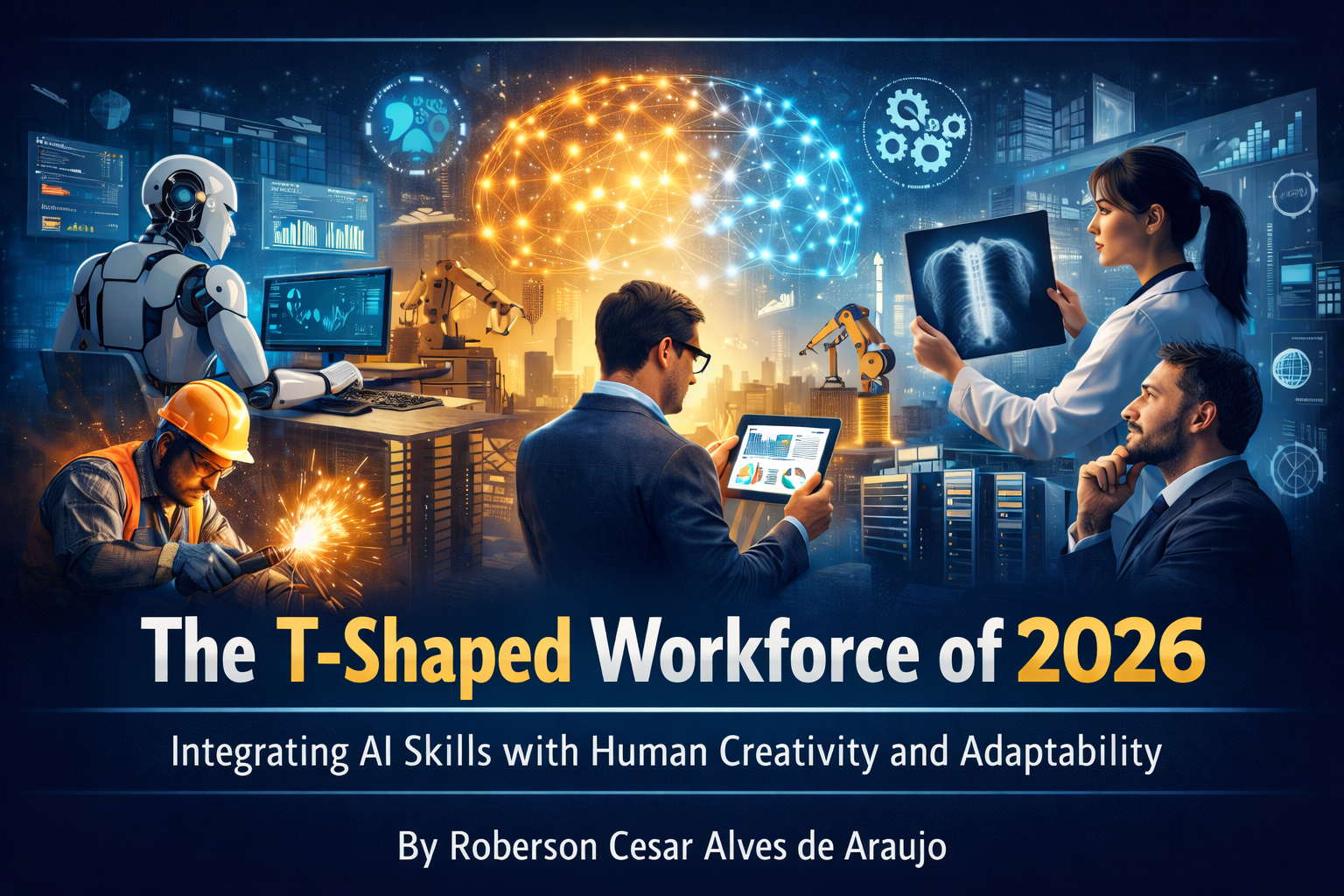
The job market in 2026 consolidates a structural shift: technology, especially Artificial Intelligence, is no longer merely a support tool and now acts as a cognitive co-pilot for professionals. In this scenario, competitive advantage is no longer based solely on technical mastery, but on the ability to integrate deep expertise, systemic thinking, and human skills. The T-shaped professional emerges with definitive strength, capable of navigating data, strategy, and creativity.
1. Artificial Intelligence Is No Longer Optional
In 2026, AI is no longer a trend, it has become the invisible infrastructure of work. Decision-support systems, cognitive automation, predictive analytics, and content generation are embedded in the daily routines of virtually every sector, from industry and education to healthcare and finance.
Professionals who fail to understand how to interact critically with AI risk becoming passive executors of automated systems. On the other hand, those who understand AI’s limits, biases, and potential are able to use technology as an amplifier of productivity and intelligence.
More than simply “knowing how to use tools,” the market increasingly values professionals who can ask the right questions, interpret results, and make responsible decisions based on them.
2. From the Isolated Specialist to the T-Shaped Professional
The dominant professional profile in 2026 is neither the shallow generalist nor the isolated specialist. It is the T-shaped professional, characterized by:
- Deep technical expertise in a specific domain (the vertical axis of the “T”),
- Combined with cross-functional vision, interdisciplinary dialogue, and business understanding (the horizontal axis).
This model directly responds to the complexity of today’s world. Real problems are not solved solely with code, data, or processes, they require integration between technology, people, ethics, and strategy.
In practice, this means professionals who can:
- Move fluidly between technical and non-technical areas;
- Translate data into decisions;
- Collaborate with diverse teams;
- Adapt quickly to new contexts.
3. Human Skills Become Even More Valuable
Paradoxically, the more advanced technology becomes, the more valuable human competencies are. Creativity, critical thinking, empathy, clear communication, and adaptability cannot be automated in the same way as operational tasks.
In 2026, these skills stop being considered “soft” and become behavioral hard skills, directly linked to performance, leadership, and employability.
Organizations seek professionals who can:
- Deal with ambiguity;
- Learn continuously;
- Work with autonomy and accountability;
- Make ethical decisions in data- and algorithm-driven environments.
4. Continuous Learning as a Survival Strategy
Degrees remain relevant, but they no longer guarantee professional longevity. What defines sustainable careers in 2026 is the ability to engage in continuous reskilling and upskilling.
Learning ceases to be episodic and becomes:
- Modular;
- Competency-based;
- Connected to real-world problems.
Digital platforms, micro-credentials, certifications, and workplace-based learning gain prominence, reinforcing the idea that a career is a process in constant beta.
5. Technology as a Partner, Not a Substitute
The narrative of “fear of replacement” loses strength in a more mature reality: AI replaces tasks, not purpose. Relevant professionals in 2026 are those who understand how to work with technology, not against it.
Competitive advantage lies in augmented intelligence, the combination of human capability and computational power. The future of work is not human or machine, but human with machine.
Conclusion: The Professional of 2026
The job market in 2026 demands more than isolated technical knowledge. It requires professionals who are:
- Technically solid;
- Humanly prepared;
- Ethically aware;
- Strategically adaptable.
The T-shaped professional, supported by AI and guided by critical thinking, represents not just a trend, but a concrete response to the complexity of the contemporary world.
Bibliographic References
- Forbes Brazil – 5 Trends That Will Redefine the World of Work in 2026
https://forbes.com.br/carreira/2026/01/5-tendencias-que-vao-redefinir-o-mundo-do-trabalho-em-2026/ - World Economic Forum – The Future of Jobs Report
https://www.weforum.org/reports/the-future-of-jobs-report-2023/ - McKinsey & Company – The State of AI
https://www.mckinsey.com/capabilities/quantumblack/our-insights/the-state-of-ai - OECD – Skills Outlook
https://www.oecd.org/education/oecd-skills-outlook/ - Harvard Business Review – The T-Shaped Professional
https://hbr.org/2018/02/the-t-shaped-professional