
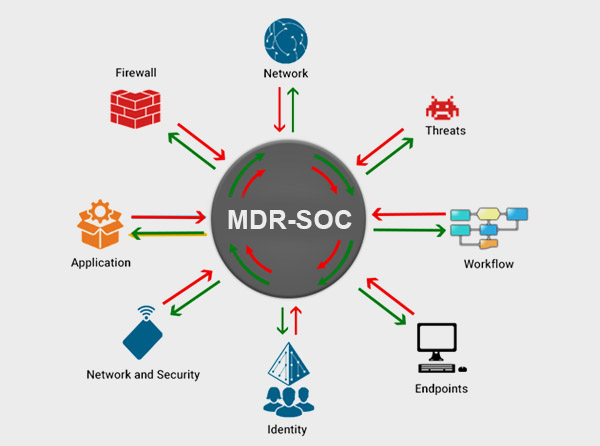
The increasing complexity of digital environments, the rapid expansion of cloud computing, and the exponential growth of cyberattacks have elevated the role of digital defense centers to an entirely new level. In this context, SOC (Security Operations Center) and MDR (Managed Detection and Response) emerge as essential pillars for continuous organizational protection — each offering complementary and strategic functions.
What is a SOC?
A Security Operations Center (SOC) is a centralized unit responsible for monitoring, detecting, analyzing, and responding to security incidents in real time. Its structure typically includes:
- Tier 1, 2, and 3 analysts
- Threat intelligence teams
- Security engineering
- Incident response leads (IR)
- 24×7 operations
- Processes and governance
A SOC operates with tools such as SIEM, UEBA, SOAR, EDR, telemetry dashboards, and multiple log sources to maintain full visibility across the environment.
Its primary mission is to anticipate threats, mitigate incidents quickly, and ensure operational continuity.
What is MDR?
Managed Detection and Response (MDR) is an outsourced advanced detection and response service designed for organizations that:
- Do not have an internal SOC
- Want to enhance their defense with 24×7 specialized expertise
An MDR service typically provides:
- Continuous monitoring
- Threat hunting
- Global threat intelligence
- Automated response actions
- Highly specialized analysts
- Executive reporting and audit support
While a traditional SOC manages internal defensive operations, MDR acts as a specialized extension, often leveraging proprietary technologies and shared intelligence gathered across thousands of environments.
SOC vs. MDR: Working Together
SOC and MDR are not competitors — they complement each other.
- The SOC operates as the organization’s command center.
- MDR offers rapid detection, expert analysis, and accelerated response capabilities.
More mature companies adopt the model:
SOC + MDR + SOAR
→ A combination that delivers visibility, intelligence, and automation, dramatically reducing MTTD, MTTR, and the financial impact of cyber incidents.
SOC and MDR Trends for the Coming Years
1. Automation and SOAR as the Standard
Manual correlation of events is becoming unsustainable.
SOAR platforms automate playbooks, triage, and initial responses, freeing analysts for strategic activities.
2. Large-Scale AI and Machine Learning
AI is becoming central to:
- Predictive analysis
- Behavioral detection (UEBA)
- False-positive reduction
- Alert prioritization
- Lateral movement identification
The SOC of the future will be AI-first.
3. Multicloud Data Integration
Hybrid and multicloud environments require:
- Unified telemetry
- Consistent policies
- End-to-end observability
Integration of logs from AWS, Azure, and GCP is becoming critical.
4. Zero Trust Embedded in SOC Operations
Zero Trust will extend beyond network architecture to become a core principle in detection and response workflows.
5. MDR as a Maturity Accelerator
As the MDR market expands, it is becoming:
- A fast-track solution for small and midsize businesses
- A complementary layer for enterprises seeking broader coverage
The trend points to hybrid MDR, integrating local data with the client’s SIEM and XDR solutions.
6. Consolidation of SIEM + XDR + SOAR
Separate tools are converging.
Market leaders are moving toward unified platforms offering:
- Detection
- Response
- Correlation
- Automation
- Native telemetry
This reduces friction and increases scalability.
7. Adoption of Universal Query Languages (KQL and Similar)
More security professionals are using KQL or similar DSLs for:
- Threat hunting
- Correlation rule creation
- Deep investigations
- Executive dashboards
The trend is toward standardized analytics across multicloud ecosystems.
Conclusion
SOC and MDR represent two complementary and indispensable pillars of modern cybersecurity.
While the SOC provides governance, control, and continuous operations, MDR adds speed, specialized expertise, and large-scale threat intelligence.
In the coming years, we will see security environments become increasingly:
- Automated
- Intelligent
- Integrated
- AI-driven
- Multicloud
- Zero Trust–oriented
Organizations that embrace the synergy between SOC and MDR today will be significantly better prepared to face the growing risks of the global cyber threat landscape.